|
|
Welcome!
Apatite-(CaF)
Posted by Rock Currier
|
|
Apatite-(CaF) May 20, 2009 09:34AM |
Registered: 7 years ago Posts: 8,476 |
![]() | |
| © |
Click here for a list of articles that are not under construction but have had at least their first drafts finished.
This article is a place holder and needs someone to take it in hand and finish the first draft. If you would like to take this article in hand, leave a reply message below or contact Rock Currier via private message by clicking on the PM button next to my name at the top of the article.
Click here to view Best Minerals A and here for Best Minerals A to Z and here for Fast Navigation of completed Best Minerals articles.
Can you help make this a better article? What good localities have we missed? Can you supply pictures of better specimens than those we show here? Can you give us more and better information about the specimens from these localities? Can you supply better geological or historical information on these localities?
Below are some preliminary notes I have made about Apatite. This entry and thread has been made as a place holder for information that you will hopefully contribute about Apatite. It should be in no way be thought of as a claim I have staked out to write about this mineral, and in fact is an invitation for someone to step forward and create the article about this mineral. If you are so inclined and have questions about the format that such an article should have, go the The welcome topic at the top of the Best Minerals forum and read what has been posted there. Also take a look at some of the more mature articles that have already been written like Rhodochrosite, Adamite, Millerite etc. You will need also to pick out other images of Apatite that will go into the article.
Apatite-(CaF)
Ca5[F|(PO4)3] Hexagonal
![]() | |
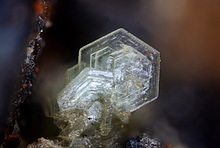
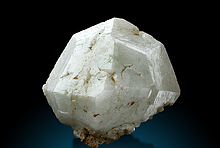
| Apatite-CaF on Albite, La Marina Mine, Pauna, Boyacá Department, Colombia 3.5cm tall | © fabreminerals.com |
Apatite, Fluor, Display collections.
Ca5(PO4)3(F,OH,CO3)
Dana’s System, 7th edition lists more than 40 localities for apatite. There is no way to identify the different apatite minerals by sight. To collectors the chemical differences in these minerals are trivial, but chemically they are important to humans. From the standpoint of your teeth, it is better for their long life if you convert the apatite in them all to fluorapatite. That is why municipalities put fluorine in the drinking water. Well over 95% of all apatites that are of interest to collectors are fluorapatites. However, unless I have been able to find a definite reference to the specimens below being a particular kind of apatite, I have just called them apatite. Most apatites fluoresce like gang busters.
Apatite is found at many localities and in different geological environments. It is sometimes found in vast quantities. In the Kola peninsula in Russia, it is mined for its phosphate content. In the form of minute microscopic crystals it has almost universal distribution as an accessory rock-forming mineral. We will comment on only a few of the better known localities that produce the best specimens. Perhaps the most valuable and sought after specimens are the glassy pink crystals from the gold mine at Moro Velho, Minas Gerais, Brazil, the purple apatite from the Pulsifer Quarry near Auburn, Maine and the dark pink to reddish apatites found in the last few years at Nagar, Pakistan. However, when you see a bunch of good ones from Portugal, you may want to add these to this list as well. You know, this is a really interesting mineral. I don’t know any collectors who specialize in this mineral, and there should be a bunch of them.
Apatite
Austria
Many good apatite specimens have been found here but they are generally not well known outside of Europe. These finds have often been limited to only a few good specimens which are snapped up by local collectors and cannot be pried loose for love nor money. If you really want to get one I might suggest a low yield nuclear device. Apatite has been found in Austria in other places than the four localities mentioned here.
Apatite
Salzburg, Habachtal (tal=valley), Prehnitinsel (Prehnite island). “Has yielded well-crystallized fluorite, apatite, adularia (to 15 kilograms!), prehnite, laumontite, apophyllite and others.”1
1 Gerhard Niedermayr, Mineralogical Record, Vol. 17, 1986 p107.
Apatite
Styria, Hochentauern, Hochentauern Mine. This magnesite mine “Produces dolomite crystals to 15 cm (pale orange in color), and gem-quality apatite crystals to several centimeters in size.”1
1 Gerhard Niedermayr, Mineralogical Record Vol.17, 1986 p110.
Apatite
Tyrol, Untersulzbachtal, Knappenwand. This locality is better known for its fabulous epidote specimens but once in a while it produces beautiful shiny white, perfectly formed, mostly transparent fluorapatite. The crystals from here are as large as 8 cm but are usually much smaller like the one pictured here from the British Museum of Natural History. It is about 3 cm in its longest direction. Most of the fluorapatites from this locality are tabular. Two generations of crystals are generally recognized, the first milky and heavily included often with green actinolite var. byssolite needles and the second being white, water clear and glassy. The Department of Mineralogy-Petrology at the Natural History Museum of Vienna has done analyses of these crystals and Robert Seemann reports that they have “1.7 to 2.6% F and 0.07% Cl”.1 Some epidote specimens from here sport these beautiful fluorapatite crystals as associations and these are guaranteed to activate your salivary glands. When this happens you know that you are in the presence of greatness. I am sure that a fine combination piece from here would bring several thousand dollars.
1 Mineralogical Record, Vol.17, 1986, p180.
Apatite
Tyrol, Zillertal and Tuxer Alps. In the region where the alps adjoin the Grossvenediger. “The thick, tabular apatite crystals reach 10 cm.”1 The ones I have seen are white tabular crystals and only somewhat translucent. Dunn2 lists the Zillertal apatites as fluorapatites.
1 Mineralogical Record, Vol.17, 1986 p107. – 2 Mineralogical Record, Vol.8, 1977, p87+.
Apatite
Bolivia
Llallagua, Siglo XX mine, Contacto Main Vein, Level 295+12m. A & B This mine produces some beautiful, shiny, white fluorapatites, mostly equant in habit, but some are slightly prismatic. They get to be a maximum of 5 cm or a little less in their greatest dimension. A few of them occur with little pyrite crystals perhaps up to 5 mm in diameter and some are associated with stannite. These crystals fluoresce an attractive bluish pink with ultraviolet light. Mark Bandy probably is responsible for most of these specimens that are in the United States. According to his wife Jean Bandy, he collected perhaps 200 single crystals and small clusters. The clusters did not exceed 15 cm and most were miniatures or thumbnails. She once showed me a wonderful little metal cookie can just jammed full of neat little specimens and let me select a superb little thumbnail specimens which had a small pyrite attached, which I cherish to this day. She told me that Mark used to sit on a little covered balcony in their home outside the portal of the Siglo XX mine and clean them with a needle. One day one of his European co-workers at the mine threw a stick of dynamite into the large pocket from which he was collecting the apatites and destroyed those that were left. She said that he did not talk to that man for months. His house was still standing outside the portal to the main adit of the Siglo XX mine in 1998.
Apatite
Potosi. Pale purple tabular crystals, some to 5 cm in diameter. These may have been from the Unificada mine or one of the hundreds of other mines that dot the mountain. I have seen enough of these to think there must be some fine ones out there somewhere. Someone please tell me where they are and send me some pictures.
Apatite
Quime, Chambillaya. Robert Cook, talking about Japan law quartz twins from this tungsten mine says “Individual members reach 6 cm in length and are occasionally associated with arsenopyrite, siderite, ferberite and exceptional pink fluorapatite crystals up to 3 cm in diameter. Twins are characteristically flattened and occur sparsely with transparent, prismatic quartz crystals generally in plates coating sulfides. Specimens are not often recovered from this occurrence and the few observed were saved by an engineer because of the transparency and perfection of the associated untwinned quartz.1
1 Robert Cook, Mineralogical Record, Vol.8, 1979 p139.
Apatite
Brazil
Minas Gerais, Nova Lima County, Nova Lima, Moro Vehlo Mine A,&B, & C. The city of Nova Lima is only 12 km from Belo Horizonte. There are a number of gold mines still operating at or near Nova Lima. The Moro Vehlo mine mentioned above, also called Mina Grande, is only one of the mines in the area. Others are Mina Vehla, Raposos, Honorio, Bicalho, Mina do Faria and Bela Fama. The mineralization of these mines is almost identical but most of the specimens seem to come from Moro Vehlo. The somewhat flat, hexagonal pink crystals from here are never more than a light to medium pink but they are often very shiny and often transparent. They fluoresce a pinkish white under short and long-wave ultraviolet radiation. A few crystals are colorless or even a light green. The largest crystals are in about 8 cm or a bit more in diameter and less than an 2 cm thick. In addition they are usually associated with attractive quartz, siderite, albite, and dolomite crystals. These specimens are light sensitive so if you get a good one, keep it in the dark. I have been told that ionizing radiation, like gamma rays, will return and intensify the color of these apatites. These apatites were never abundant and I don’t think I have ever seen more than three or four specimens together at one time. In all of my 20 plus trip to Brazil, I have been able to get less than three decent specimens and these were by no means the best. The best ones from here are certainly in the $10,000 plus range.
Apatite
Minas Gerais, Itatiaia District, Jonas mine. “…pink apatite crystals, very sharp, lustrous and gemmy…”.1 These were brought to the Tucson show in 81 by Carlos Barbosa. I think the largest of these was less than 2 cm. Can someone point me to a good specimen or a picture of one?
1 Mineralogical Record, Vol.12, 1981 p183.
Apatite
Minas Gerais, Governador Valadares, Golconda Mine. At the 1986 Denver show, Carlos Barbosa brought up from Brazil “a small find of attractive violet-pink apatite crystals recovered in August…The largest crystal (about 3x7 cm) and several others were being offered by Roberts Minerals (Ken Roberts). Some crystals are associated with bertrandite.”1
1 Mineralogical Record, Vol. 18, 1987, p148.
Apatite
Minas Gerais, Virgim da Lapa. The three main pegmatite mines near Virgim da Lapa that produce specimens are the Limoeiro mine (lemon tree in Portuguese), Toca da Onca mine (lion’s cave) and the Xanda mine. The crystals from these mines are fluorapatite here (mine not specified) “Two crystals (38 by 91 mm & 24 by 56 mm) were pale green in the cores and pale purple in the exterior zones, with interesting modifications and striations. The luster was slightly dull, due perhaps to a quick wash in acid by the miners.”1 These two crystals were imported by Milton Sklar and sold at the 1977 Detroit show. One wonders how many of these were produced at the mine. Line drawing of one of the crystals appeared in Mineralogical record.1 Also “Generally fluorapatite forms brilliant, complexly modified crystals with tan, yellow, blue, purple, green or rarely black color and strong color zoning. Matrix, where preserved, is albite and sometimes lepidolite. At the Toca da Onca mine, spectacular, brilliant doubly terminated, tabular crystals up to 15 cm were found on a matrix of albite.”2
1 Mineralogical record Vol.9, 1978 p38. – 2 J.P. Cassedanne & Jack Lowell, Mineralogical Record, Vol.13, 1982 p19.
Apatite
Minas Gerais, Medena County, Lavra (mine) da Campolina. Crystal clusters of transparent to translucent light root beer or sherry colored fluorapatites. These are frequently sharp, shiny and sometimes completely transparent. The crystals can be up to 8 cm long and frequently come in somewhat intergrown but complete clusters. These clusters can be up to 20 cm or more across. This find was a fairly large one. There were several hundred pieces I was told. Some of these specimens sold for several thousand dollars when they were found back in the 1987 and I am sure have not gone down in price. I have a particularly fine small specimen in my collection that I cherish.
Apatite
Minas Gerais, Rio Doce Basin, Conselheiro Pena township, Ze Pinto Mine. This mine is located in a pegmatite on the Fazenda Santa Elisa, 43 km east-northeast of Conselheiro Pena, also in Minas Gerais state. This mine is probably better known for its beautifully crystallized muscovite specimens but Jacques P. Cassedanne and Jeanette Alves, authors of the Mineralogical Record article on the Ze Pinto mine think it is a major apatite locality as well. They say; “Second stage apatite has made the locality immediately famous among mineral collectors. Zé Pinto apatites are reminiscent of crystals from Panasqueira, Portugal, though somewhat more opaque and elongated. The common forms are the first-order and the basil pinacoid {0001}. In some cases the prism edges are beveled by a second-order prism, and the pinacoid edges by one or two first-order and sometimes also by a second-order bipyramid. Some bipyramid faces are slightly hoppered. Generally the prisms are up to 4 cm in length and 1 to 3 cm in diameter, larger crystals are rare. They occur singly and in intergrown groups without any preferred orientation. Surfaces may be smooth or a complex mass of parallel terminations and faces. Color is bottle green to dark green or black and also pale blue to blue-green in thin late-stage overgrowths. Most crystals are somewhat translucent to opaque, and only rarely transparent on thin edges; all are internally fractured, and no faceting-grade material has been found. Secondary healing of fractures and overgrowth of fracture surfaces, two-phase inclusions, and flakes of a metallic mineral have been observed in crystals. Zoning is also common, and luster is typically brilliant, although the prism faces can be somewhat striated. Apatite crystals occur in groups with muscovite and white feldspar, sometimes also with smoky quartz crystals. Powdery albite and tiny quartz crystals stud the surfaces of some apatites. Over 100 kilograms of apatite crystals were recovered from the same large pocket which yielded the muscovite specimens. Hundreds of fine specimens have reached the market, especially at the 1990 Tucson Show.”1 These apatites are fluorapatites.
The key part in the above description is that the crystals are somewhat more opaque than those from Panasqueira. Most collectors would not put these apatite crystals on the same quality level as those from Panasqueira, Portugal. They are usually darker and blacker as well. I visited the mine while it was still producing muscovite specimens and must have bought over a thousand mica specimens, but never got a good apatite from tere for my collection. The good ones were very uncommon. There were a few large muscovite pseudomorphs or rather epimorphs after apatite, up to 15 cm, where well formed muscovite crystals grew over the surface of a large apatite crystals. The apatite was subsequently dissolved leaving a covering of muscovite crystals with a distinct hexagonal outline.
1 Mineralogical Record, Vol.21, 1990, P405+ pictures on p407.
Apatite
Minas Gerais, Paraiba. Deep blue fluorapatite crystals up to approximately 2 cm sometimes growing on green tourmaline. Short prisms with pyramid and minor basal pinacoid terminations. There is a fine picture of a wonderful specimen of these apatite crystals growing on a green tourmaline crystal in the Mineralogical Record, Vol.32, 2001 p494.
Apatite
Minas Gerais, Pederneira Mine Hexagonal dark purple crystals up to about 5 cm with mica and albite. The specimen in my collection is a cluster of these apatite crystals measuring 6x10 cm. Some collectors mistake it for tourmaline. This mine is now much better known for its fine tourmaline specimens. Value on a specimen like this would probably be $4,000. The find was rather limited.
Apatite
Minas Gerais. There are dark blue, hexagonal prismatic crystals that are found enclosed in calcite and I will give a better locality for these when I get one. These are usually kind of melted looking like their greenish and bluish cousins from Ontario, Canada and Sludanka, Russia. Occasionally they get a presentable specimen like the one shown here. Large crystals exist but I have never seen a good crystal that was more than 8 cm in length. Most of the time these apatite crystals are made into tumbled polished stones, cabochons or other small lapidary objects. Sometimes they find some clear material in some of the crystals and cut beautiful, sub 1carat, faceted stones from it.
Perhaps Paulo Viega or Ricardo Fabrin or Marcelo Ziebenberg can help with these.
Apatite
Minas Gerais. Apatite pseudomorphs after eosphorite like the 8 cm cluster of prismatic, brown pseudomorphs shown here. Probably other phosphate minerals are also altered to apatite and other minerals.
Perhaps you can tell me where in Brazil it is from?
Apatite
Burma
Mogok District. Fine light blue, gemmy, prismatic crystals come from gem gravels of Mogok. Perhaps up to about 5 cm in length. John Sinkankas pictures one in his fine book, Mineralogy for Amateurs, p417.
Apatite
Canada
Ontario, Renfrew, Lanark, Frontenac and Haliburton counties and Ottawa County, Quebec. The two specimens pictured here are from Eganvill, Renfrew Co. Ontario and Wilberforce Ontario. “As shown by Dunn (1977), the majority of the classic Canadian apatite specimens are probably fluorapatite. To list all the occurrences from which fine crystals have been recovered would be impossible. However, the prolific localities certainly include Turner’s Island in Lake Clear, and the nearby Meany and Smart mines, all near Eganville, Renfrew County. At the Liscombe mine near Wilberforce, gem-quality crystals have recently been mined and marketed under the trade name “trilliumite.” The Silver Crater mine near Bancroft, the Smith-Lacey mine near Sydenham, the Taggart mine near Crow Lake, the Gibson Road occurrence near Torry Hill and the Richardson property near Wilberforce have all produced significant numbers of excellent specimens. Dark blue crystals resembling those from Lake Baikal in the Soviet Union have also been found near Canoe Lake, Bedford Township. For a more complete account of the apatite occurrences in the Grenville Formation, the reader is referred to1, 2, 3,
1. Spence (1920) (George Robinson & Steven C. Chamberlain, Mineralogical Record, Mar/Apr 1982 p73; 2 Dunn, P. J. (1977) Apatite, a guide to species nomenclature. Mineralogical Record, 8, 78-82; 3 Spence, H.S. (1920 Phosphate in Canada. Canada Mines Branch Publ. 396.
“Large crystals enclosed in marble occur in many deposits in Renfrew, Lanark, Frontenac and Haliburton counties, Ontario; also in Ottawa County, Quebec. Individuals to 500 pounds are recorded, while single crystals, many doubly terminated, from 2” to 12” long and ½” to 3” diameter, have been offered as mineral specimens. Fine matrix specimens are provided by green, asparagus colored, crystals in pink calcite, the latter chipped away carefully to expose the apatite crystals. All Canadian crystals are severely checked and cracked, and most crumble when removed from matrix, thus making undamaged crystals rare despite their abundance in situ. Occasionally, clear fragments can be cut into faceted gems. Canadian apatites are easily recognized by the curious rounding of prism and termination edges.”1 Tons of specimens have been produced over the years. These specimens make good display pieces for museums. Collectors, should they want one, can buy a decent small specimen for less than $50.
1 John Sinkankas, Mineralogy for Amateurs, p418. – 2 Mineralogical Record, July/Aug 1974 p178+.
In November of 1889 at the Aetna mine “A perfectly formed” crystal, 7 feet long and 4 feet wide and estimated to weigh 6 tons was found. The owners of the mine, The Anglo-Continental Guano Company, took great pride in showing this crystal, in situ, to visitors of the mine” 1 They tried to take it out intact, but were not successful. They were the ones that described this monster as perfectly formed and considering the time and circumstances they can certainly be forgiven.
1. Donald D. Hogarth’s excellent article on the discovery of apatite in this area in the Mineralogical Record.
Apatite
Chile
Copiapo. Yellow crystals, translucent up to 5x8 cm. Sharp, well terminated hexagonal crystals. I think these are from an iron deposit like their cousins from Durango, Mexico but I have seen only one fine, large crystal in the collection of the School of Mines at Copiapo, Chile.
Terry Szenics knows the locality for these specimens. You have a picture of one being held in the hand of the curator. They were found north of Copiapo near where the road to Inca de Oro crosses a railroad track.
Apatite
Czech Republic
Bohemia, Schlaggenwald. An old locality you see in many mineralogies but rarely see specimens in collections, especially here in the United States. I would really like to see a good apatite from there.
Apatite
Slavkov Don’t know much about these, but the specimen pictured here is in the British Museum of Natural History and it has a nice 3 cm crystal with a greenish center and a purple overgrowth. There had to be other and probably better ones. Talk to me!
Ask Jaroslav how good the specimens from here get and if there are many of them around.
Apatite
Pisek Cute little blue crystals on matrix. The one pictured here was in Arthur Montgomery’s collection. Anybody know of better ones?
Ask Jaroslav how good the specimens from here get and if there are many of them around.
Apatite
England
Cornwall, Luxulyan, Colcerrow Quarry The specimen pictured here is a sharp shiny blue green crystal of about 3 cm on matrix. Of course this one in the British Museum of Natural History might be the best one ever found, but that is not likely.
Apatite
Devon, Bovey Tracey. The only reason I included this one is because it is in the British Museum of Natural History and is not a bad looking specimen even if the main crystal looks as though it is filled in with cement.
Apatite
Germany
Saxony, Ehrenfriedersdorf, on Greifenstein. “Beautiful purplish tabular crystals to ¾ on matrix from the tin mine in central Europe as near Ehrenfriedersdorf,…”1. Crystals are sometimes a good purple color. Most crystals are simple hexagonal shapes more tabular than prismatic with simple pinacoids. They are fluorapatites. The little beauty pictured here is associated with quartz and pyrite crystals. This locality is over 100 years old and you rarely see these specimens. Production of them was never great.
1. Mineralogy for Amateurs, John Sinkankas, 1964, p. 418.
Apatite
Japan
Tochigi Prefecture, Ashio mine, A.& B. “occur in the druses of chalcopyrite veins and Kajika deposits, together with chalcopyrite, quartz and other sulfide minerals, and show a wide variety of crystal habit. Hexagonal short prismatic habit with well developed (0001), (1010) is the most common. Hexagonal platy crystals and those with equally developed (0001), (1011), (1010) are also observed. Crystals are usually 3 to 10 mm in diameter, but often as large as 3 cm. Most interesting are minute crystals of hexagonal platy or short prismatic habit often aggregated together in sub-parallel orientation forming aggregations of sponge-form, dendritic-form or bead-form.”1 There are some respectable specimens from this mine. All the specimens I have seen have white translucent to transparent crystals like the two shown here.
1 Introduction to Japanese Minerals, Geological Survey of Japan 1970 p181.
Ask Alfredo if he has seen any of these.
Apatite
Kanagawa Prefecture, Kurokura. “Apatite crystals at Kurokura occur in quartz-chlorite-apatite veins in diorite, in association with quartz, desmine, talc, etc. Crystals are prismatic with well developed (0001) (1011) faces and are usually 1 cm in length, but often exceed 4 cm. Although their surfaces are white translucent, the inner part is honey colored and transparent.”1
1 Introduction to Japanese Minerals, Geological Survey of Japan 1970 p181.
Apatite
Mexico
Durango, Ciudad Durango, Cerro de Mercado A & B & C & D. is well known for its sharp, lustrous, bright yellow, prismatic fluorapatite crystals from the iron mine at Cerro de Mercado, in Durango State. Tens of thousands of these crystals have flooded the market over the years but most of them were single crystals. Recently they have gotten quite scarce and like all specimens that were once abundant you can’t help wondering where they all went. Willard Perkin, a well known dealer in Southern California during the 60’s, 70’s & 80’s, who made many trips to Mexico to buy mineral specimens, once told me that he was offered a 55 gallon drum full of these crystals. Good matrix specimens are hard to get. Some of the crystals are completely transparent and cut good gemstones, some clean over 15 carats. Most crystals are under 2 cm in diameter and less than 7 cm tall, but, to collectors, crystal size is not as important as luster, transparency and having well formed crystals on or in the matrix. How much will the better specimens bring? I have never heard of one selling for more than $1000, but then I have not seen a fine one for sale recently.
The apatite crystals from Cerro de Mercado appear to have grown elsewhere, been broken off and then recemented with other rock and mineral fragments into the rock in which they are found. Matrix specimens of this material are produced when fortune and careful work have removed enough of this secondary matrix to show the apatites to good advantage.
Apatite
Morocco
Imilchil. Small, transparent, well formed, shiny hexagonal amber colored crystals. Crystals get up to about 3 cm. I don’t know much about this locality. There is a good picture of one in the Mineralogical Record.1
1 Mineralogical Record, Vol. 32, 2001 p492.
Apatite
Namibia
Seeis farm, Onganja, Emky mine. This cute little toenail size specimen is associated with calcite. Only one I have seen from this locality, but there must have been others.
Apatite
Otjua mine near Karibib. “Blue and lilac-purple color-zoned fluorapatite crystals to 4 cm on albite have been found.”1 Brian Lees of Denver Colorado sold many specimens from this mine.
1 Mineralogical Record Vol., 23, 1992 p435.
Apatite
Øyna, Froland. “gray-green fluorapatite crystals several centimeters across”. I have never seen one of these.
Apatite
Pakistan
Nagar, Fiqhar, and Chumar Bakhoor. Chumar Bakhoor is not a village but an area of pasturage. The best pink to dark pink fluorapatite crystals in Pakistan are from the region around the villages of Nagar and Fiqhar, if indeed these place names are villages. Nagar is also a district name. Some specimens have been given the locality name Allabad which is a nearby village but is on the main road along the Hunza river which links Pakistan with China. These crystals are frequently associated with aquamarine, fluorite, possibly muscovite mica and other pegmatite minerals. The best specimens I have seen have all been good association pieces and the fluorapatite crystals tend to be isolated individuals associated with other minerals. The apatite crystals are usually simple blocky hexagonal prisms that occasionally measure more than 3 cm diameter. I have not heard of any that have surpassed 5 cm in diameter. In the Freilich auction there was a 8.25 cm specimen of cream colored mica crystals that sported a well formed hexagonal orange red apatite perhaps a little over 3.75 cm with minor aquamarine that had a low estimate of $25,000. The specimen did not sell although a bid of $15,000 might have purchased it.
Apatite
Haramosh Valley, between Gilgit & Skardu. In What’s New in Minerals in the Mineralogical Record 1980 there was this interesting note. “One consists of two long, pale blue beryl crystals on matrix of mica books and beautiful pink apatite crystals to an inch or so.”1 This was one of the specimens in a lot that Herb Obodda brought back from Pakistan and “Probably the best specimens were bought by David Wilber”1 . This is a perfect example of how misleading locality information gets into the literature, especially when it is a new locality and dealers are trying to keep competition from learning where the good specimens are coming from. The specimen described above is almost certainly from the Fiqhar and Chumar Bakhoor region described above.
The entire region of the Haramosh Mountains east of Gilgit has a number of localities that produce fine apatite specimens. Some of the specimens are more distinguished by their mineralogical associations than the virtue of their apatites. One small thumbnail size specimen of a sceptered Schorl tourmaline growing on a doubly terminated tan apatite crystal brought $6,000 in the 2001 Sotheby’s auction. I stopped at Dasu village once and an old man came running toward our car with a filthy old rice bag full of specimens. In the middle of a fallow field I bought the lot for $75. The best specimen was a shiny well terminated black Schorl crystal about 12 cm long with a half dozen well formed hexagonal cream to tan apatite crystals up to about 2 cm growing on it. See Dudley Blauwets excellent article in the Mineralogical Record about localities in Pakistan. Vol. 28, 1997 p183+.
1 Mineralogical Record, Vol. 11, 1980, p 321.
Apatite
Portugal
Panasqueira A & B & C & D & E. The mine at Panasqueira, Portugal has produced some spectacular greenish apatites. The color is usually a little on the olive green side and often zoned. Some of the crystals from here are a pleasant lavender color but are not as common as their gray green cousins. They can reach 8 cm in diameter but many of the best specimens have smaller crystals. They are usually translucent, bright and shiny and often have elegant associations of quartz, arsenopyrite, wolframite etc. I have heard of fine specimens from this locality being sold for many thousands of dollars. Has one been sold for more than $10,000? I think so.
Apatite
Monte Redondo. At the dolerite quarries of Monte Redondo about 150 km north of Lisbon they find white prismatic apatite crystals up to 3 mm in diameter and up to 4 cm long. These long thin white crystals are terminated with first order pyramid faces. These strange crystals would certainly puzzle your friends even if they did not excite envy which every mineral collector worth his salt strives for. The locality is better known for its exceptional actinolite specimens.
Apatite
Russia
Kola Peninsula, Murmansk Oblast, Khibiny Massif. Most of the apatite from this locality is a granular massive greenish or yellowish fluorapatite with brownish spots of other minerals. Occasionally a few crystals of the yellow saamite variety that contains strontium and rare earth elements. These crystals, sometimes as large as 2 cm and transparent. Similar yellow fluorapatite crystals up to 15 cm but opaque are found in the Lovozero Massif. These crystals have the form of simple prisms with a pinacoid termination. The main reason the apatite from this locality is mentioned is that it forms one of the largest commercial sources of apatite in the world. The deposit was discovered by Alexander Labuntsov in about when he and Alexander Fersman were doing a geological survey in the region looking for pegmatites that might have a potential for gemstones. Labuntsov found places where the vein of apatite that was exposed on the Khibiny Massif was 200 meters in thickness. Commercial mining soon commenced, most of it from open pits and it still continues today.
Apatite
Ural Mountains, Kiryabinsky Mine. I know nothing about this locality other than the specimen pictured here is in the British Museum of Natural History. These 3 cm, white, shiny, transparent crystals would grace any collection.
Apatite
Irkutsk, Sludanka. At the south end of Lake Baikal is the little mica mining town of Sludanka. Here, blue green fluorapatite crystals are found similar in nature to the crystals from Ontario Canada are found. Sludanka translates as Micatown or Micaville in English and it was at the heart of the Russian mica industry since about 1925. In the veins associated with the mica is a lot of cream to orange calcite often containing numerous attractive blue green fluorapatite crystals up to the size of your fist. Large quantities of these specimens have been collected, but it has been only in the last ten years than any quantity of them have made their way to western markets. They are kind of melted looking like the ones from Ontario, Canada. You should be able to get a really good one for less than $500.
Apatite
Takowaja River, east of Ekaterinburg, Ural Mountains. This locality is listed in many texts as a good locality for apatites, but the crystals are whitish and are found growing in a mica schist. By today’s standards they do not excite much interest from collectors.
Apatite
Spain
Murcia, Jumilla. The yellow crystals that are found here occur as terminated prisms with calcite on volcanic rock. Dana’s system, 7th edition says that they occur in an andesite-tuff. I don’t think you could make a living selling these.
Apatite
Sweden
Vermland, Gellivare in Norrbotten and Nordmark. The specimen pictured here is a sharp partially transparent, lustrous yellow crystal 2 cm long and wide. One wonders how abundant they were when first found.
Apatite
Switzerland
Grisons, Tavetish. The specimen here may almost be a better quartz specimen than an apatite, but the little pink apatite lurking near the base of the quartz crystals sure makes it a lot more appealing. There are probably a lot of good Swiss apatites hidden away in collections in Switzerland and Europe. Usually, Swiss collectors sell their first born rather than part with good Swiss specimens.
Apatite
Alpe Della Sella at Gletsch. Also the St. Gotthard region generally. “Splendid sharp white to colorless tabular crystals to 2½” diameter”.1
1 Mineralogy for Amateurs, Sinkankas p418.
Apatite
United States
California, San Diego County, Mesa Grande, Himalaya Mine. (fluorapatite) “Beautiful pink apatite crystals are associated with tourmaline pockets found in certain portions of the Himalaya mine. Numerous fine crystals exist, however, many have been ruined since they fade rapidly to an unattractive white in sunlight. Among the finest is a 13/4 x 3/8-inch doubly terminated crystal attached to the top of a 1½x1-inch green tourmaline. (J. Scripps collection)”1 I am sure that you would have to pay several thousand dollars for such a specimen if it were ever for sale. Sinkankas says that crystals up to 10 cm have been found. Single crystals in the 3 cm range usually do not sell for more than $100. Dr. Eugene Ford, venerable guru and pegmatite expert, who did his Ph.D. thesis on the Himalaya dyke system says about the apatite crystals found here; “The color ranges from a light pink to a deep wine-red for some crystals, and from pale sky-blue to medium blue for others. Some pockets contain apatite crystals with pink centers and blue rims. The contact between the two colors is sharp and is analogous to the green caps on pink tourmalines. Most of the apatite found is strongly fluorescent under ultraviolet light. The maximum crystal size reported is about 3x2x2 inches, and the habit is generally short to moderately elongate prismatic”.2 The crystals that are found here are not abundant and are mostly in the thumbnail size range. I am not sure I should have taken so much space describing these crystals but what ever Gene Ford has said is worth hearing.
1 Mineralogical Record, Vol.8, 1977 p514. – 2 Mineralogical Record, Vol.8, 1977 p461.
Apatite
San Diego County, Clark Mine. “One large 3x2-inch cluster of four deep blue apatite crystals, lightly dusted with muscovite crystals, is known from the Clark mine.”1 This specimen was in the collection of Josephine Scripps, a collection which Bill Larson of Fallbrook, California dispersed. I have no idea how you would place a value on such a rare animal as this. $500?, $5,000?
1 Mineralogical Record, Vol. 8, 1977, p 514.
Apatite
Colorado, Eagle County, Gillman, Eagle Mine A & B. These little flat tabular hexagonal green to pale violet crystals up to about a centimeter are often found growing on pyrite crystals. These make particularly appealing specimens if the specimen size is small. They were not found in any great quantity, just now and then in small lots. You could probably get a decent one for less than $200 if you could find it for sale. The ones pictured here would certainly cost a fair bit more.
Apatite
Connecticut, Portland, Strickland Quarry. “at least one other American locality produced fine, large royal-purple apatite crystals which are essentially indistinguishable from Pulsifer specimens. Early in this century the Strickland quarry in Portland, Connecticut, produced an unknown number of very fine apatites. Two damaged crystals of the darkest purple color can still be seen in the Harvard collection and one exceptional crystal was, until recently, in the Wesleyan University collection. F.E. Strickland’s personal collection contained a crystal measuring 5x3x1 cm, in a group with a number of smaller crystals, on a matrix of white albite crystals, and associated with a very minor amount of partially altered pyrite. Every knowledgeable dealer and collector to whom I have shown this specimen believed that any apatite of such size, color and clarity must have come from Maine.”1
1 Russell E. Behnke, Mineralogical Record July/Aug p330.
Apatite
Haddam Neck, Gelette Quarry. “Fluorapatite from Gelette is well known for its brilliant yellow fluorescence under short-wave ultraviolet radiation. Most fluorapatites are found encased in feldspar. More rarely, crystals 3.2 cm across have been found in pockets. It is interesting to note that these crystals do not fluoresce as intensly as the imbedded crystals. Fluorapatite crystals range in color from pale green to pale purple, sometimes with both colors in a single crystal. The Yale collection contains a very fine specimen with four fluorapatites up to 3.2 cm on a matrix of quartz and cleavelandite crystals with a 1-cm ferrocolumbite crystal. (C2802, Brush collection)”1
1 Jeffrey A. Scovil, Mineralogical Record, Vol.23, 1992, p25.
Apatite
Maine, Androscoggin County, Auburn, Mt. Apatite, Pulsifer Quarry A & B Some people hold that these are the best apatites in the world because of their rich purple color. If you want a good apatite from the United States, the kind most collectors dream about is one of the purple apatites from the Pulsifer Quarry. These are shiny and a rich blue purple color and in general the crystals are less than 3 cm and many fine specimens have crystals no larger than a centimeter. Some are associated with quartz crystals. Good small specimens can easily bring more than a thousand dollars and the best several tens of thousands. One of the best is probably the “Robeling” apatite in the Smithsonian Institute. It is a miniature size specimen and some people consider it the finest apatite specimen in the world. “In 1901 Pitt P. Pulsifer discovered a gem pocket in a pegmatite on his farm. Mr. Pitt would start work on his “quarry” after the hay was in on his farm and would stop when he has used up the $100 he had budgeted for his hobby. The size of the original quarry was 3x8x8 meters which shows that it was really more of a prospect pit than anything else. Wolf and Palache (1902) commented that the find was “noteworthy for the unusually rich purple color of the [apatite] crystals”; Palache acquired most of the specimens for Harvard University. About 2000 crystals of purple apatite were recovered from this one pocket.”1
1 Wendell Wilson, Mineralogical Record, Vol. 8, 1977, p72.
The description of the 1902 pocket is worth reading. “The pocket contained: about 2000 crystals of purple apatite with a total weight of about 1 kilogram. Included were about a dozen large groups on matrix, and about 300 loose crystals having at least one perfect termination, 500 crystals were slightly less perfect and the remaining 1200 crystals were imperfect or fragmentary. The pocket consisted of a single cavity lined with crystals of quartz, orthoclase and lepidolite, accompanied by small amounts of albite, muscovite and cookeite. The quartz crystals ranged up to 15 cm…. The bulk of the pocket was sold to Harvard University.”1 This description speaks volumes about the values that collectors had at that time if you can read between the lines. Certainly the best one and probably the best ones did not go to Harvard. Certainly the Robeling piece got away. If all you know is that there were 2000 specimens found your mind will carry you to false conclusions. 2000 pieces in 1kg?? The pocket was probably smaller than a bread box and most of the apatites had to be the size of peas or smaller. Probably a lot of great micro crystals. How much did the dozen large groups weigh? They could not have been very big because the balance of the 1988 pieces in the pocket made up the kilogram of specimens. This is really typical of most pockets that contain fine specimens. Less than 10% of the specimens are worth more than the balance of the material taken from the pockets.
1 Wolf, J.E. and Palache, C. (1902 Apatite from Minot, Maine. Proc. Am. Acad. Arts and Sci., 37, 517-529.
Over the years other people have dug in the quarry with varying degrees of success. In 1945 Stan Perham did a dig there and found two good pockets, the first of which had tourmaline as well as good purple apatites. However the content of the second pocket “was blown out into the woods by a charge of dynamite and never found!” Terry Szenics did a dig at this quarry in 1966-7 that brought a number of fine purple fluorapatites to light. A good one will cost you several thousand dollars if you can find one to buy. I don’t think that anyone has tried to do any mining in this quarry since then and most consider it exhausted.
Apatite
Maine, Androscoggin County, Auburn, a prospect west of the Wade quarry. “Duddie Grovs, of Poland, Maine and Dick Dionne, of Erroll, New Hampshire, have reopened a prospect west of the Wade quarry, near Auburn. Several world-class purple fluorapatite crystals to 3 cm have been found along with one unterminated elbaite crystal….”.1 In spite of living in New York, Van is “Mr. Maine” for all intents and purposes. As you might imagine, he may be a bit biased in favor of minerals from Maine. He is not a half bad mineralogist and knows a good specimen when he sees one. He has a wicked sense of humor and is always willing to help stir the pot if there is fun to be had from almost any sort of mischief.
1 Vandall King, Mineralogical Record Vol.24 p382.
Apatite
Maine, Mt. Rubelite near Hebron. “In the fall of that year (1985) Jim Mann made the first really significant find at Mt. Rubellite since 1934, with his discovery of purple fluorapatite crystals up to 2.5 cm. Last fall, Jim had a repeat performance. What started out to be a weeks worth of exploration and development work ended up as 34 days of quite productive mining. Among the more noteworthy finds were two isolated pockets of quartz containing excellent smoky crystals and several fine scepters, a 30x30x50-cm pocket and a 25-cm pocket that yielded some of the best fluorapatite crystal groups found to date…”1 This locality produced some fine specimens but the color is not considered as good as some of the other localities. This is typical of many small finds that are made each year by field collectors. They work their hearts out for years, and once in a while they are rewarded in a small way for their efforts. I would wager that even Mr. Mann would agree that he could have made more money in the long run by flipping hamburgers at the local McDonalds. But then, most of us are not really in this for the money and the thrill of finding a good pocket of minerals is not something you can usually buy with money.
1 Mineralogical Record, Vol. 21, 1990, p 483.
Apatite
Massachusetts, Hampshire, Pelham. “Excellent crystals to 3”, with actinolite and asbestos”.1 I have never seen any of these, but if John says they are good then they must be good. Does anyone know where any of these are or know where a picture of a good one is?
1 John Sinkankas, Mineralogy p418.
Apatite
North Carolina, Kings Mountain, Foot mine A & B. But check out the elegant specimen of pale pink flying saucer shaped crystals from the Foot mine. Wouldn’t you just love to have this little darling?
Apatite
New York, Antwerp, Tilly Foster Mine. Apatite is always mentioned as one of the minerals that occur in good specimens from this long abandoned iron mine. Though I have looked long and hard I have never seen one that would gather more than a glance and a ho hum! from present day collectors. I have included a picture here so you can see what you are not missing.
Apatite
South Dakota, Custer County, Keystone, King Lithia Mine. These fluorapatites rated an article in the Mineralogical Record.1 The largest crystals described were about 12 mm and most were much smaller. They were white with a blue to purple overgrowth and mostly simple tabular hexagonal habits but most crystals exhibited an interesting white stripe around them. There find was rather limited and almost certainly fewer than 100 decent specimens were found. Other pegmatites in the region have also produced decent apatite specimens but in very small quantities. Crystals from the South Dakota pegmatites are as large at 3 cm. About 25 percent of them are prismatic in nature and the rest are not. In the collection of the School of Mines in Rapid City South Dakota there is a specimen of slightly prismatic apatite crystals that makes a radial ball of cream colored apatites that measures about 5 cm in diameter.
1 Mineralogical Record, Vol. 15, 1984, p 365.
I could go on and on describing crystals from other localities, but at this point I will just direct you to look at the pictures from various localities in this record. The pictures were taken because I thought that the specimens were the best I had seen for the locality. There are probably two or three dozen more localities that produce specimens worthy of inclusion here, and, as soon as you tell me about them, I will include them here.
Click here to view Best Minerals A and here for Best Minerals A to Z and here for Fast Navigation of completed Best Minerals articles.
Rock Currier
Crystals not pistols.
Edited 4 time(s). Last edit at 12/25/2012 11:16PM by Rock Currier.
|
|
Re: Apatite-(CaCl), (CaF), (CaOH), (CaOH)-M, (SrOH) May 20, 2009 10:26AM |
|
Registered: 7 years ago Posts: 2,158 |
|
|
Re: Apatite-(CaCl), (CaF), (CaOH), (CaOH)-M, (SrOH) May 20, 2009 11:04AM |
|
Registered: 7 years ago Posts: 3,762 |
Apatite
Germany
Saxony, Ehrenfriedersdorf, on Greifenstein. “Beautiful purplish tabular crystals to ¾ on matrix from the tin mine in central Europe as near Ehrenfriedersdorf,…”1. Crystals are sometimes a good purple color. Most crystals are simple hexagonal shapes more tabular than prismatic with simple pinacoids. They are fluorapatites. The little beauty pictured here is associated with quartz and pyrite crystals. This locality is over 100 years old and you rarely see these specimens. Production of them was never great.
1. Mineralogy for Amateurs, John Sinkankas, 1964, p. 418
Something has been mixed up here. Both the tin mine (= Sauberg Mine) and the Greifenstein outcrops have produced fluorapatite, but they are different localities. The Greifenstein fluorapatites are always purple; those from Sauberg came in a variety of colours.
Germany
Saxony, Ehrenfriedersdorf, on Greifenstein. “Beautiful purplish tabular crystals to ¾ on matrix from the tin mine in central Europe as near Ehrenfriedersdorf,…”1. Crystals are sometimes a good purple color. Most crystals are simple hexagonal shapes more tabular than prismatic with simple pinacoids. They are fluorapatites. The little beauty pictured here is associated with quartz and pyrite crystals. This locality is over 100 years old and you rarely see these specimens. Production of them was never great.
1. Mineralogy for Amateurs, John Sinkankas, 1964, p. 418
Something has been mixed up here. Both the tin mine (= Sauberg Mine) and the Greifenstein outcrops have produced fluorapatite, but they are different localities. The Greifenstein fluorapatites are always purple; those from Sauberg came in a variety of colours.
|
|
Re: Apatite-(CaCl), (CaF), (CaOH), (CaOH)-M, (SrOH) May 20, 2009 08:16PM |
Registered: 7 years ago Posts: 8,476 |
|
Anonymous User
Re: Apatite-(CaCl), (CaF), (CaOH), (CaOH)-M, (SrOH) May 20, 2009 10:53PM |
|
|
Re: Apatite-(CaF) September 15, 2009 11:53AM |
|
Registered: 5 years ago Posts: 718 |
Hello,
I agree with Peter on the apatites from Saxony.
Those apatites from the Greifenstein locality came from cavities in quartz veins crosscutting a tin granite (a granite with pneumatolytic overprint). The Greifenstein area is named after it's very strange looking granite "towers" (natural rocks). There are seven today, 6 have been destroyed in quarry work, beeing small lakes now. Apatite can still be fond in the wood, although it's a nature preservation area and collecting with tools is forbidden. It's probably the type locality of 'apatite'. The biggest I#ve found there has been about 1 cm.
The there are the Greifenstein adit and the Sauberg Mine, both being separate localities. In the GDR tin has been mined there. The cassiterite occurs together with apatite-(CaF), fuorite, topaz, quartz, arsenopyrite, molybdenite, wolframite and muscovite (sericite-like, called 'gilbertite' there). Apatite xls are tabular to prismatic, colouredd differently with mostly pink, yellow or greenish colours. They can be up to about 1 cm.
Then there are other localites in German Granites. Quite nite ones have been found at Epprechtstein, Fichtelgebirge, Bavaria in miarolitic cavities.
Nice prismatic fluorapatites are known from a small rhyolite outcrop (with adit of former hydromuscovite (illite) mine) in the Riesenwald area, Ohlsbach, Kinzig Valley, Black Forest. Those are up to 2 cm, forming radial sprays. Prevalent colours are blue or blueish green, often with zoning (blue endings, orangy brown center of the aggregates). Will upload some pictures of those.
Regards,
Sebastian Möller
Edited 1 time(s). Last edit at 09/15/2009 11:59AM by Sebastian Möller.
I agree with Peter on the apatites from Saxony.
Those apatites from the Greifenstein locality came from cavities in quartz veins crosscutting a tin granite (a granite with pneumatolytic overprint). The Greifenstein area is named after it's very strange looking granite "towers" (natural rocks). There are seven today, 6 have been destroyed in quarry work, beeing small lakes now. Apatite can still be fond in the wood, although it's a nature preservation area and collecting with tools is forbidden. It's probably the type locality of 'apatite'. The biggest I#ve found there has been about 1 cm.
The there are the Greifenstein adit and the Sauberg Mine, both being separate localities. In the GDR tin has been mined there. The cassiterite occurs together with apatite-(CaF), fuorite, topaz, quartz, arsenopyrite, molybdenite, wolframite and muscovite (sericite-like, called 'gilbertite' there). Apatite xls are tabular to prismatic, colouredd differently with mostly pink, yellow or greenish colours. They can be up to about 1 cm.
Then there are other localites in German Granites. Quite nite ones have been found at Epprechtstein, Fichtelgebirge, Bavaria in miarolitic cavities.
Nice prismatic fluorapatites are known from a small rhyolite outcrop (with adit of former hydromuscovite (illite) mine) in the Riesenwald area, Ohlsbach, Kinzig Valley, Black Forest. Those are up to 2 cm, forming radial sprays. Prevalent colours are blue or blueish green, often with zoning (blue endings, orangy brown center of the aggregates). Will upload some pictures of those.
Regards,
Sebastian Möller
Edited 1 time(s). Last edit at 09/15/2009 11:59AM by Sebastian Möller.
|
Re: Apatite-(CaF) February 19, 2010 04:04AM |
Registered: 5 years ago Posts: 184 |
Apatite from Tilly Foster? Antwerp, NY?
The Tilly Foster Mine is near Brewster, NY, which about 400 miles from Antwerp, NY. One of the reasons that Tilly Foster was mined was that the ore was exceptionally low in phosphorus. I would suspect that little or no apatite was ever found there.
|
Re: Apatite-(CaF) February 19, 2010 07:45AM |
|
Registered: 3 years ago Posts: 328 |
I would not name the colour of the Greifenstein Apatites as purple. The colour is lilac resp. mauve.
Besides the locations Greifensteine and Ehrenfriedersdorf there are still abt. 20 other locations of Apatites in Saxony. Nearly all of the old mining areas have apatites as well as the most quarries of the granite zones.
Uwe Ludwig
Besides the locations Greifensteine and Ehrenfriedersdorf there are still abt. 20 other locations of Apatites in Saxony. Nearly all of the old mining areas have apatites as well as the most quarries of the granite zones.
Uwe Ludwig
|
|
Re: Apatite-(CaF) February 19, 2010 07:05PM |
|
Registered: 7 years ago Posts: 2,363 |
Rock, some of the best and largest Apatites in Austria came from the Finagl Mt: [www.mindat.org]
I've seen gorgeous specimens of up to 6 cm large yellow Apatites in clusters up to 15 cm on large Pericline plates.
I'll ask the strahler who collected them (from a fissure in the middle of a 400 meters steep to overhanging rock face.......) for a photograph.
I've seen gorgeous specimens of up to 6 cm large yellow Apatites in clusters up to 15 cm on large Pericline plates.
I'll ask the strahler who collected them (from a fissure in the middle of a 400 meters steep to overhanging rock face.......) for a photograph.
|
|
Re: Apatite-(CaF) February 19, 2010 08:43PM |
Registered: 7 years ago Posts: 8,476 |
All of the above comments and suggestions are valid and I am sure that when the article is written (what appears above is just a place holder with a little rudimentary information that I have compiled. Other such good comments and suggestions are welcome.
Rock Currier
Crystals not pistols.
Rock Currier
Crystals not pistols.
|
|
Re: Apatite-(CaF) February 19, 2010 10:12PM |
Registered: 5 years ago Posts: 172 |
|
|
Re: Apatite-(CaF) February 19, 2010 10:59PM |
Registered: 7 years ago Posts: 8,476 |
|
|
Re: Apatite-(CaF) February 23, 2010 01:43PM |
|
Registered: 7 years ago Posts: 1,306 |
Great start, Rock.
It should be mentioned that many of the pink apatites (especially from Pakistan) are very sensitive to fading in daylight. I know museums and collectors who have used top$$$ to buy such specimens only to experience that they have turned colourless in only 1 year of exposure to daylight (not even direct sunlight) when on display. I am not sure about the pink apatites from other localities.
|
|
Re: Apatite-(CaF) February 23, 2010 05:05PM |
|
Registered: 7 years ago Posts: 1,054 |
|
|
Re: Apatite-(CaF) February 23, 2010 06:20PM |
Registered: 7 years ago Posts: 8,476 |
|
|
Re: Apatite-(CaF) June 14, 2012 10:26AM |
|
Registered: 1 year ago Posts: 289 |
|
|
Re: Apatite-(CaF) June 14, 2012 06:36PM |
Registered: 7 years ago Posts: 8,476 |
John,
Those apatites look a little rough to me, but may be good enough to include in the best minerals Apatite article when someone gets around to writing it. Especially if you can tell us something about the locality, its geology, history and specimen production.
Rock Currier
Crystals not pistols.
Those apatites look a little rough to me, but may be good enough to include in the best minerals Apatite article when someone gets around to writing it. Especially if you can tell us something about the locality, its geology, history and specimen production.
Rock Currier
Crystals not pistols.
Copyright © Jolyon Ralph and Ida Chau 1993-2013. Site Map.
Locality, mineral & photograph data are the copyright of the individuals who submitted them. Site hosted & developed by Jolyon Ralph.
Mindat.org is an online information resource dedicated to providing free mineralogical information to all. Mindat relies on the contributions of thousands of members and supporters. Mindat does not offer minerals for sale. If you would like to add information to improve the quality of our database, then click here
to register.
Current server date and time: 19th May 2013 00:02:06
Mindat Lightbox
Options| Fade toolbar when not in focus | Fix toolbar to bottom of page | ||
|---|---|---|---|
| Hide Social Media Links | |||
| Slideshow frame delay | seconds | ||